CHILDREN SHOULD READ OLD BOOKS TOO
Background: How I encourage my children to read
Building a strong reading habit is a top priority and so I do what I can to encourage the habit. Books coat our home, the kids know screens are for after reading, and I talk with the the kids about the books they’ve read. As it stands, my sons—13, 9, and 6 years old—love reading.
They come by their books differently. Mr. 6’s picks comes mainly from inside the house, and some from the school library. Mr. 9’s choices are like his younger brother’s, but with more library books. Mr. 13—on the cusp of high school—more often reads books his English teacher assigns.
I step in a little. I’m intent that my children will read some choice titles before they’re grown, and so I make sure those are on hand. Thankfully these been easy sells. McCloskey’s Make Way For Ducklings, Watterson’s Calvin & Hobbes, Emerson’s Self-Reliance, and Seneca’s Moral Letters have all been big hits in the house.
On top of these—and some other—foundational works, I tell the young ones to read what they want. They’re more able than I to find a book that they love, a book that will go through them. Piggie and Gerald, Amulet, and Hunger Games, are books I would never have thought to offer, but still they sparked wildly.
That spark is the whole thing. If spotted and cared for it can become a roaring fire, ready to wholly consume ever bulkier and greater works. So I ask them questions about the book, tell them how cool I think the book is—there’s always something cool about it—and take them to the bookstore to buy more fuel for the fire. This worked well with my oldest. By the time he was eleven the fire was roaring. He had the habit.
Why are the books all so new?
In the midst of all this I noticed the newness of the books my kids were reading. For example, here are of some of the books Mr. 13 was into as he was building his habit.
- Captain Underpants (1997)
- Elephant and Piggie (2007)
- Diary of a Wimpy Kid (2007)
- Hunger Games (2008)
- Amulet (2008)
- The Maze Runner (2009)
- Ready Player One (2011)
- Wings of Fire (2012)
- Dog man (2016)
- Pax (2016)
- Diary of an 8-bit Warrior (2016)
These are good books that have lived on my shelves for years. Still, it struck me as odd that they’re nearly all from the last 15 years, and none existed when Tupac was alive. I can’t say for sure, but I guess that new books crowd out older ones as publishers hunt for a hit they can turn into a series. Something where they can bang out installments that are sure to sell. Hard to do that with old books. Also, maybe teachers find it easier to get kids to read new books?
In any case, I felt this affection for the early 21st century meant my son was missing out on most of the best books ever written. So I gathered a body of books for us to read together.
In this way he’s found new favorites like Treasure Island, Gulliver’s Travels, and Animal Farm. He’s strengthened his reading by grappling with more challenging sentences in Melville’s Billy Budd. He’s deepened his understanding of America through Douglass’s A Narrative of the Life of Frederick Douglass, an American Slave. These and other writers—among them Homer, Plato, Xenophon, Seneca, Lincoln, Tolstoy, Crane, Twain, Bradbury, and more—have shaped my son as sure as they’ve shaped the the world we live in today.
In short, it was a win. He’s a stronger reader, able to spot arid stretches in books ripe for skimming (I’m looking at you, Robinson Crusoe), and parse convoluted sentences. We’ve had some wonderful talks about ideas like happiness, duty, and politics. Maybe best of all, by my son’s own account he is proud that he’s read these books.
8th grade reading units from the Lucy Calkins curriculum
Which brings me to today. I’ve said my eldest son is getting more books assigned to him by his English teacher. That, more schoolwork, and a more independent social life mean scarce reading time. So I spoke with his teacher to see what were her plans were for the year. I hoped to find a way to read some books from our list that would also fulfill some academic requirement.
The teacher told me that the school uses the “Lucy Calkins curriculum”. I’d never heard of it, so I looked her up. She’s the founder of the Teachers College Reading and Writing Project out of Columbia University.
I looked for a list of books in the curriculum, but it all roads led to Heinemann, a publisher. They sell themed “shelves” but keep most of the titles hidden. They only let window shoppers like me get a peek at some representative titles on “this page”(archive.org) and in this catalog.
The teacher told me that this year they would have three themed reading units: “dystopian”, “literary non-fiction”, and “critical literacy”.
Conveniently, page 46 and 47 in the catalog has sections with those same titles. The story is the same as above: poor Tupac never got the chance to see any of these titles.
I’ve written the titles along with the descriptions (edited for conciseness) of each section below.
“Dystopian” books and description
- Among the Hidden (1998)
- The City of Ember (2003)
- Hunger Games (2008)
- The Roar (2012)
- The Age of Miracles (2012)
These include typical fantasy tropes: battles of good versus evil, heroes, quests, and magic. You could use these books in a study of symbolism or of interpretation or in social-issues book clubs. We considered that in a classroom of middle school students, you might find some avid fantasy and dystopian readers and also some students who are not interested in or familiar with the genre. For this reason, we picked some well-known books like The Hunger Games, as well as some lesser-known gems.
“Literary nonfiction” books and description
- Drowned City (2015) [This appears to be a comic book]
- Vietnam: A History of the War (2016)
- Fred Korematsu Speaks Up (2017)
- Unpunished Murder (2018)
These are designed to engage readers in a deeper, more nuanced study of nonfiction reading. We searched high and low for nonfiction that would not only engage students, but would immerse them in heart-rending storytelling, fascinating juxtaposition of subtopics, sophisticated sentence structure and features, and challenging density or length.
“Critical literacy” books and description
- The Epic Fail of Arturo Zamora (2017)
- All American Boys (2015)
- The Poet X (2018)
- Look Both Ways (2019)
- Genesis Begins Again (2019)
These are concerned with cultural relevance and getting teens to fall in love with books because the books they read are deeply meaningful to the lives they are living right now. If you examine the winners of the most prominent literary awards for young people you will find incredible novels by authors who work to understand young people, embed their narratives in contemporary cultures, and take up the urgent social issues that shape teens’ lives.
My additions
I hope that this sliver isn’t representative of the whole. I hope that worthwhile old books live on these shelves. Mostly I hope that my sons get to read some of these great old books in school.
But hope isn’t enough, so below I recommend books that the school should add as options for 8th graders to read during each of the reading units.
Let me be perfectly clear: I am not saying that the school should take away any books. Nor am I saying that the books I want to add are the only books that should be added. I am saying the school should add the books below to the list of options right next the books that are already there.
I base my recommendations on a book’s importance, not whether I like it or not. While I must say that I do like most of the books below, I dislike some.
Dystopian
Few question which are the iconic dystopian books: Huxley, Bradbury, and Orwell have defined the genre for generations. It Can’t Happen Here hasn’t reached those lofty heights, but it an icon in its own right and stands out for starting the story in what feels like a normal world.
We should add:
- HUXLEY, Brave New World (1931)
- LEWIS, It Can’t Happen Here (1935)
- BRADBURY, Fahrenheit 451 (1953)†*
- ORWELL, Nineteen Eighty-Four (1949)*
† on “Classics” shelf sample titles *My son’s teacher already had these in the reading unit
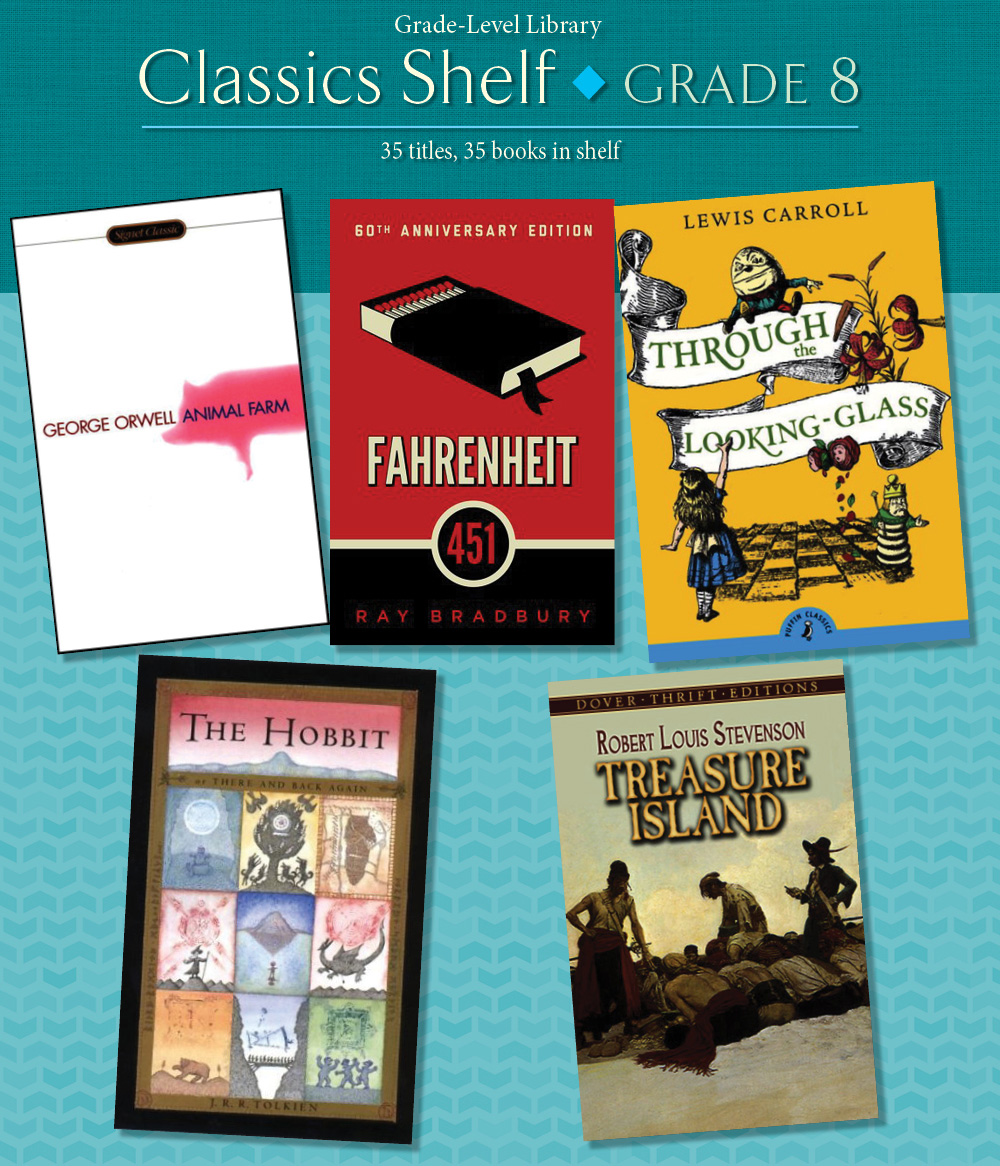
Literary Non-fiction
Here the boundaries are fuzzier than usual, but the curriculum’s aim is worthwhile:
to engage readers in a deeper, more nuanced study of nonfiction reading…. sophisticated sentence structure and features, and challenging density or length.
The books in the curriculum all ground the story in some historical event. It’s a good tactic (I especially like what I see in Unpunished Murder after a quick inspection), but history isn’t the only material that writers can shape into literary non-fiction.
Science is fertile ground. Hawking and Carson—writing about the the universe and the environment, respectively—dropped technical terms to draw in everyday people into weighty scientific topics. It worked.
Personal experience is likewise fruitful. Generations of children have related their anxieties and enthusiasms and rebellions of youth to how Thoreau felt when he went into the woods to live deliberately. Maya Angelou’s transformation in the face of adversity is equal parts relatable and inspiring.
Nor are novel-length works the only option. Hawking, Carson, Thoreau, and Angelou are great, but we’d miss much if we avoided essays. Montaigne invented the form and his Of the Education of Children is both widely read and profoundly relevant to 8th graders. Following his path—among countless others—are Emerson, Thoreau, Baldwin, and White. Each wielded the form to weigh in both on the pressing issues of their day and their own peculiar ordeals.
That these essays are at once engaging and tightly written (White is the author both of Charlotte’s Web and the Elements of Style) makes them perfect tools for a curriculum like my son’s that interweaves writing and reading units.
We should add:
- MONTAIGNE, Essays, esp. Of The Education of Children (1580)
- EMERSON, Essays, esp. Self-Reliance (1841)
- THOREAU, Walden, Civil Disobedience (1854)
- BALDWIN, Notes of a Native Son (1955)
- CARSON, Silent Spring (1962)
- ANGELOU, I Know Why The Caged Bird Sings (1962)
- WHITE, Essays (1977)
- HAWKING, A Brief History of Time (1988)
Critical Literacy
I’ll admit to being slightly confused at the naming here. I understand someone being “critically literate” means that they can discern where a text has a hidden bias. However, the description above says:
These are concerned with cultural relevance and getting teens to fall in love with books because the books they read are deeply meaningful to the lives they are living right now….take up the urgent social issues that shape teens’ lives.
That reads closer to another meaning of “critical”. One that highlights differences among a society’s groups rather than cultivate a skill in detecting bias. Both are good, but I’ll stick closer to the stated aims rather than the title they chose.
It’s easy to read their their description (especially "meaningful to the lives they are living right now" ) and think that old books don’t fit in. That would be wrong; they fit just right.
Old books fit because the past is the only thing that makes the present coherent. We’ve see this in critical works forever. They compare the topic of the day against history. How could they do otherwise? In a sense, to write a critical work is to take account of history and use it to judge where we are.
A real danger lurks here, for 8th graders and everyone else. It is easy to fall into the habit of letting contemporary writers tell you what to think about the past. The surest way to thwart such mindlessness is to for people to read those oft-cited old works themselves.
With that in mind, these books ought to be on hand for 8th graders alongside modern works.
- DOUGLASS, Narrative of the Life of Frederick Douglass, an American Slave (1845)
- DU BOIS, The Souls of Black Folk (1903)
- WOOLF, A Room of One’s Own (1929)
- ELLISON, Invisible Man (1952)
- BALDWIN, Notes of a Native Son (1955)
- FRIEDAN, The Feminine Mystique (1963)
- KING JR, Where do we go from here: Chaos or Community? (1967)
Conclusion
People in every era are unavoidably at the leading edge of history. It’s natural then that they, and us, to to see our circumstances as particular to our time. It’s natural to feel that the contemporary voices—the ones talking about what’s going on right now—are the only ones people need to hear.
Yet when we look back we see the truth. We see that, despite the differences, the same ideas come up over and over again. Love, power, war, sects, god, truth, family, etc. The questions surrounding these ideas, let alone the interplay between them, have not been settled.
I’m just some guy, but it strikes me as the pre-tense of knowledge to think that the past has nothing to teach. It’s foolish to limit our children to writings that are scarcely older than they if our aim is—as it is for me—to turn them into the informed, broad-minded, wise adults we need them to become.